Into the Breach: the Life of a Marine
Butch Holden
was born one year after his father returned home from World War II. This is his story.
Tobin has been recording his father's stories while he still can and will be collaborating with Butch's family, friends and the young people he impacted through his work with the Boys and Girls Clubs of America. Check back as Tobin will be giving sneak previews of this biography of an astounding Marine.
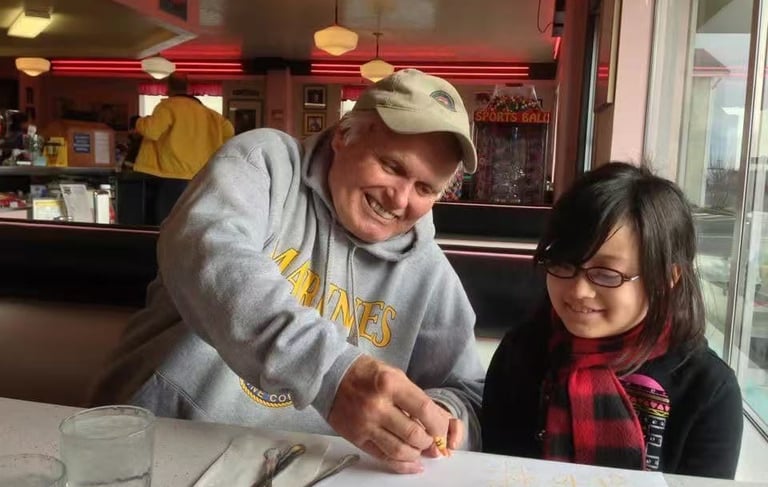
Getting closer...
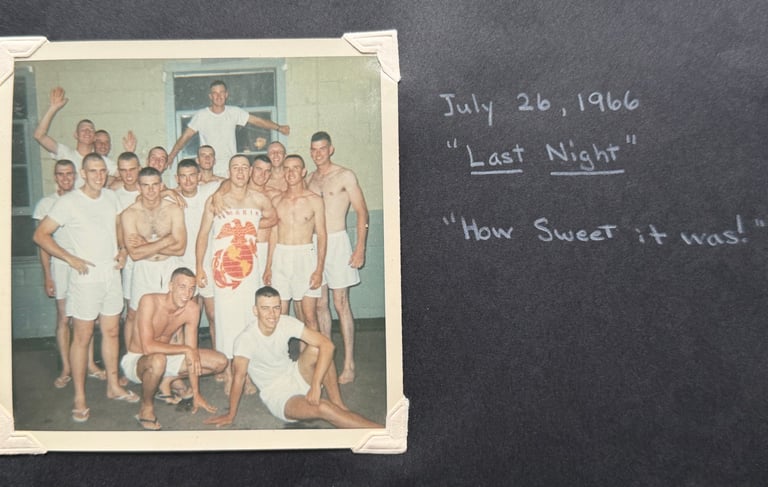
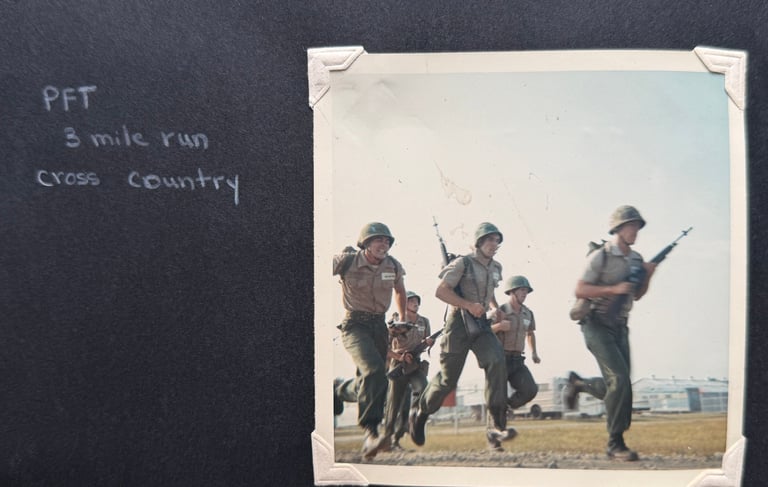
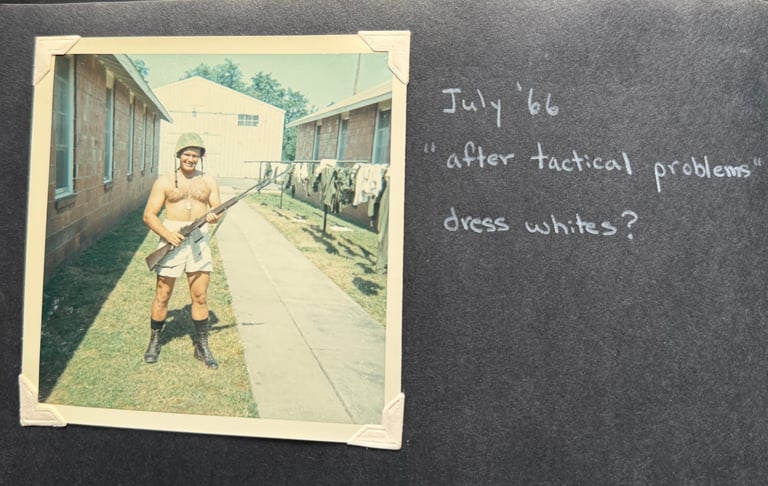
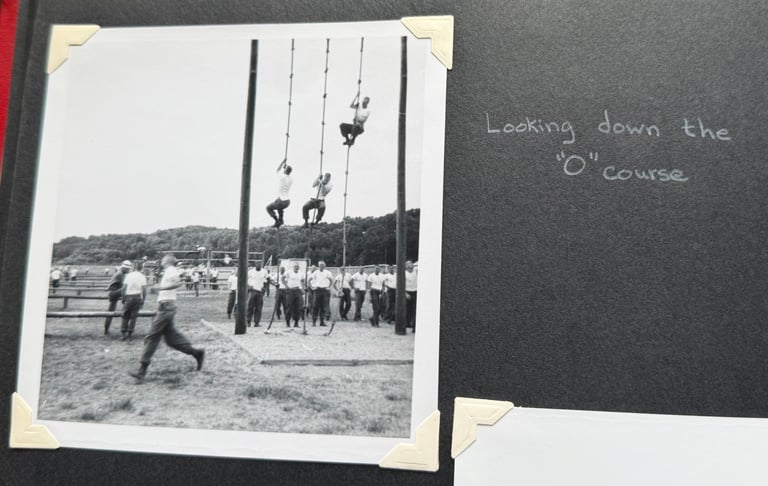
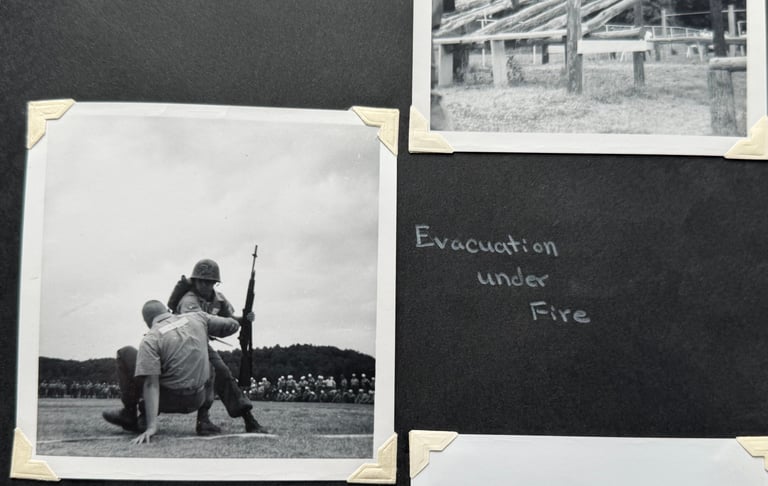
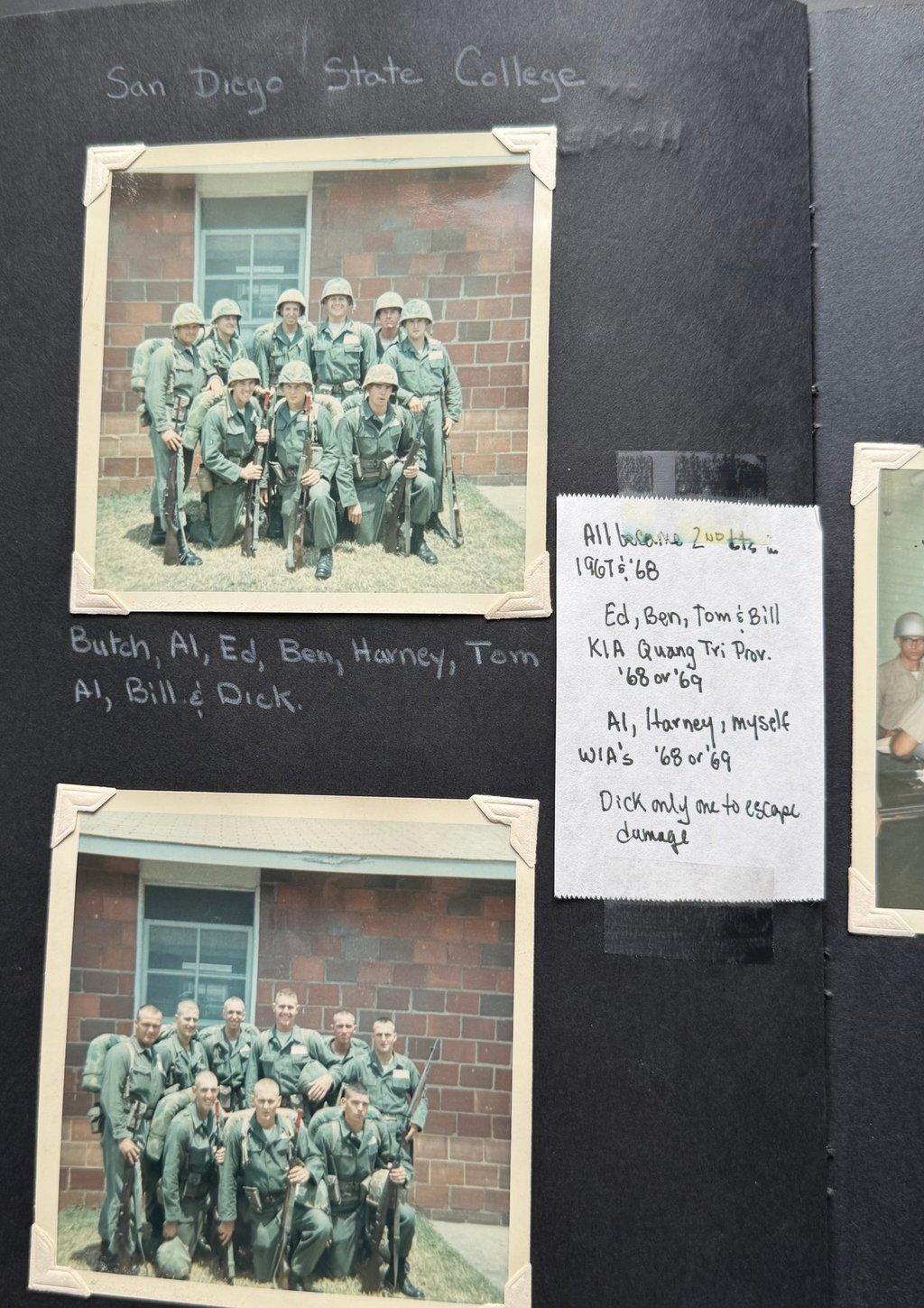
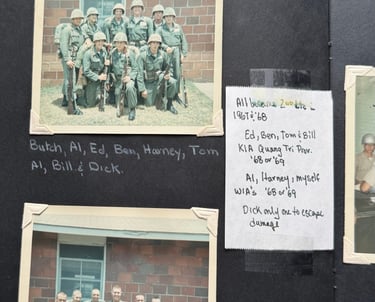
With over 43 recorded interviews both in per person and via phone, I am working through the transcripts, consolidating, checking for historical accuracy, and editing. The interviews cover stories of his father's exploits in the 1st Raider Battalion, growing up in a Marine family, preparation for Service, Butch's experiences in Vietnam and some stateside stories after the war. The photos displayed here are from Butch's old photo album when he was in Platoon Leadership School and Officer Training School.
Here is a sample of one of our sessions:
Interview Transcript with edits — Interview 14
Personal Memoir: Harold “Butch” Holden
Covers: Vietnam — The Mining of the Landing Craft / The Rescue / Hospital Ship / The Purple Heart / Ocean View / The 4th Marines / End of Tour
The River: Mining of the Landing Craft
Coming Down the Cua Viet
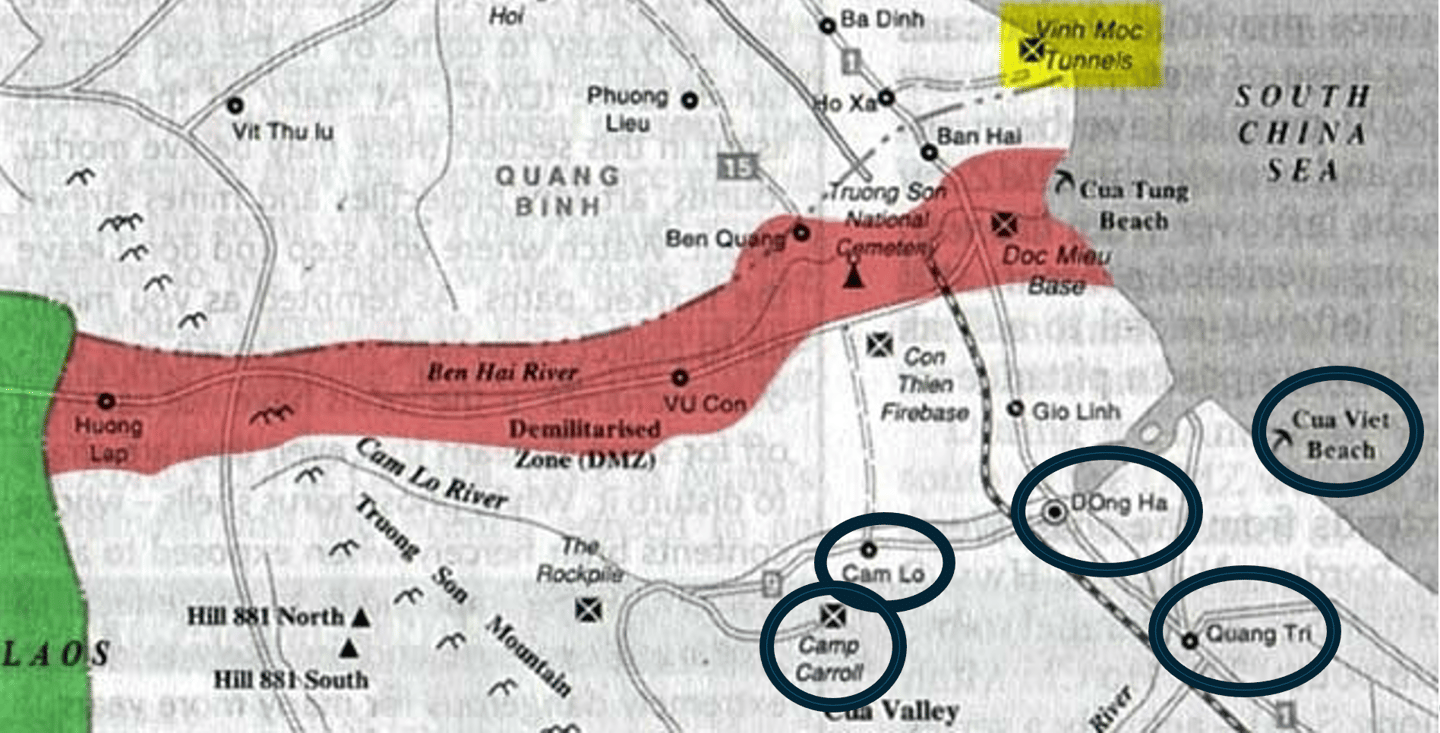
The monsoons were bad that time of year. I had come in from the field after about forty days out, back to the rear at Dong Ha to write some reports and do some administrative work. My platoon was down in Cua Viet, and the only way to get there was either by helicopter or by riverboat — the roads had been cut and were getting hit in ambushes. The helicopters weren’t flying. So, I went down to the little boat pier they had at the river landing where supplies came off the bigger ships from the ocean. Cua Viet sat right on the ocean at the mouth of the river it was named after, which flowed into the South China Sea.
The landing craft was a standard LCVP — a Higgins-style boat like they used on D-Day, flat-bottomed, with a drop ramp at the front and a raised coxswain’s position at the stern. We had two .50 caliber machine guns mounted back there. A Navy first class petty officer was running it, with a couple of sailors up forward who would throw grenades in the water periodically to try to concussion-detonate any mines ahead of us.
There were fifteen Marines aboard going down to Cua Viet — some of them were from the battalion rear of the 9th Marine Amphibious Battalion, the unit that ran supplies by Amtrak to outposts along the beach. They got mined regularly too. One of the reasons my platoon was down at Cua Viet was to sweep the beaches at dawn before the Amtraks made their runs, particularly to a place called Ocean View — our northernmost outpost in South Vietnam.
It was raining hard. I was standing at the stern in my jacket and helmet, pack on, rifle, the whole kit, trying to stay out of the worst of the weather. Lashed in the middle of the cargo deck was a six-by-six truck. The driver was a young lance corporal, couldn’t have been more than eighteen or nineteen. He came back up to where I was standing and said, “Sir, would you like to get in the truck?” He had a canvas roof and windshield — he’d stay dry in there. I don’t know why, but I just said no. I told him to go ask the war correspondent instead.
There was a civilian war correspondent on the boat — a Black man, friendly, who had been moving around talking to the Marines during the trip. These boats are slow and he was making the rounds. The lance corporal went over and asked him, and he climbed into the truck cab too.
We came around a bend in the river and there was a landing craft that had just been hit. It was smoking. People were pulling bodies and wounded off and landing them on the south bank of the river — the south side was ours during the day, at least nominally. The north side was a different story after dark.
All fifteen Marines on our boat went to the port rail to look at the other craft. I was still standing at the stern.
The mine went off underneath me.
Right Where I Was Standing
I know it went off directly beneath me because of what I saw later. When we made it to the beach at Cua Viet, the Navy had a crane barge there that had pulled up the wreckage. They had both landing craft sitting on sawhorses — mine and the one that had been hit before us. I remember the number on ours to this day: 33. I walked around to the stern, right where I’d been standing, and looked down. The mine had come up through the bottom of the hull at that exact spot, blown out the planking, and the explosion had thrown me down onto the cargo deck among the fifteen Marines who had all been leaning on the other rail.
The blast threw me down into the boat. The truck went over the side.
When I came to enough to think, I was bleeding from my nose and ears. I had a concussion. I was lying in a mess of bodies and gear on the cargo deck. The front ramp had dropped on impact with a sandbar — we were stuck, taking on water through the front, maybe four to six inches deep, but held by the bar. The engine was out.
I said, “Where the hell is the truck?”
Someone said, “It went over the side.”
I said, “Where's the driver? Where's the correspondent?”
Nobody had seen them so I went over the side.
The water was monsoon water — brown, opaque, running hard from the mountains upstream. You couldn’t see your hand in front of your face. But it wasn’t deep there. The truck was about eight feet down. I could feel it. I got the door partway open and got the lance corporal out. He was still alive. Got him around to the front of the boat and he was able to swim to the ramp.
The correspondent was still in the cab. There was a small pocket of air trapped at the top of the inverted cab when I went back under. I got the door open enough to get him out — the first pull didn’t work, I had to come back up, grab something off the boat, go back down and pull again. I got him up. I got both of them out.
I was told later at the medical facility ashore that the correspondent didn’t make it. To this day I don’t know for certain. I never got a definitive answer. I hope he did.
Getting Off the River
I got back on the boat. Blood was all over the cargo deck. The deck was slick — water, blood, diesel — and when I climbed up the ramp I slipped and did something to my hip. Not a dislocation, but something popped or tore. I was gimping around for a week or more afterward. I’ve wondered since whether that was the beginning of my disc problems. The paralyzed veterans evaluator who reviewed my case later wrote it up as a separate injury from the acoustic trauma. He also noted the acoustic neuroma — caused by proximity to the explosion — which I’ve had ever since.
I couldn’t hear for about a day after the blast. I don’t remember getting to the hospital ship. They flew us out — I was told I was unconscious for part of it. I came to with surgeons all over me.
I spent a week to ten days on the ship. They worked on my teeth — I had broken out several and had a fractured jaw — and monitored the concussion. At some point during the stay they stopped the ship and a cruiser, the USS New Jersey, came alongside. You could look out over the rail and see her sixteen-inch gun turrets. They were using her to hit rocket sites and artillery positions along the coast. When they fired at night, the rounds going overhead sounded like a rocket ship passing. Two-thousand-pound shells. The whole ship shuddered.
[NOTE TO Self: The USS New Jersey (BB-62) was reactivated in 1968 and deployed to Vietnam, where she provided naval gunfire support along the I Corps coastline. Her sixteen-inch guns fired 5,688 rounds during this deployment. ]
The Hospital Ship: Scotch, Nurses, and an Ensign with a .45
The XO Brings Scotch
I was in the officer’s ward. My roommate was a Marine captain who’d taken grenade fragmentation — red blood spots all over his body, surgeons coming in every day with scalpels and tweezers to pull pieces out of him. He took it stoically. Good man.
My XO, Dean, came out to the ship to see how I was doing. He brought two bottles of Scotch whisky — sealed, stateside labels. He set one out. We hadn’t seen Scotch in a long time. We had to taste it. We had to taste it some more.
The ship was anchored not far from Cua Viet. Somewhere in the afternoon they had a barbecue on the stern for ambulatory patients — canvas overhead for shade, real food, fresh air. The captain and I went, still in our blue hospital pajamas, bare feet. We still smelled like the jungle but real food was great.
Ten Steps to Heaven
The officer’s ward was below the sun deck reserved for the ship’s officers and the nurses. About ten steps up. The captain looked at me.
He said, “We could be in heaven in about ten steps.”
We were pretty well along on that scotch by then.
We went up. Blue pajamas, bare feet, smelling like the bush. The nurses were up there talking and laughing and we started talking with them — it was really good. We hadn’t seen American women in a long time. There’d been one USO show at the battalion — an all-female group from South Korea, and later a group of about fifty-year-old women who could really sing. The troops went absolutely crazy for them, Black Marines and White Marines alike, everybody going nuts. But American nurses on a sun deck was on another level.
The Officer of the Deck came up. A Navy ensign, OD armband, .45 on his hip. He asked what unit we were with. The captain told him we were goddamn United States Marines, and maybe the ensign should think about his next move. The ensign called up two more sailors. The sailors looked at each other and then looked at us and clearly did not want any part of us.
The ensign made a mistake. He pulled his .45.
The captain squinted at him and said, “Are you going to take us in, Ensign?”
Then the captain started laughing.
The OD called up six more sailors. Then they wisely also called the Marine guard detail — the ship kept a small Marine contingent to handle exactly this kind of patient situation. A Marine major came up.
He looked at us and said, ”Okay, Captain. Okay, Lieutenant. Downstairs. Now.”
He ran us a full riot act back in the ward. Wanted to know where we got the Scotch. We said someone had left it in the back of the boat and we found it. He clearly didn’t believe us and clearly wasn’t going to push it. He said the captain of the ship wanted to see us in his office at 0900. In uniform.
We didn’t have uniforms — they’d been cut off us when we came aboard. The major said they’d get us into utilities and boots.
The Commander’s Office
0900. The major, two sailor SPs, us. We got ushered into the captain’s office. The captain wasn’t there — the XO, a commander, was sitting at the desk. Head in his hands over a stack of paperwork.
He dismissed the major and told the others to wait outside. Then he looked up at us.
He said he’d been in the United States Navy for twenty-two years and had never had anything like this happen on one of his ships. He called us every name in the book — some I’d never even heard. He said he was writing letters to our commands recommending court martials. He was going to see us thrown out of the service and it would serve us right.
And he sent us back to the ward.
The Purple Heart and the Letter
The Ceremony
There was a USO show and a ceremony aboard the ship while I was there, with some awards being given out. That’s when I got my Purple Heart — for the landing craft mining. I had no idea it was coming. I hadn’t known where or when it was going to happen.
The ceremony was quiet. Simple. I remember it.
Back on the Beach
When I got off the hospital ship, I went back to Dong Ha and then immediately flew out to Ocean View, where the platoon was still working. I checked in with the battalion commander. He called me in, wanted to know about the mining incident, how I was doing, what had happened out there. It was the second time I’d ever met him personally.
He never mentioned the commander’s letter. Not a word. I figured maybe it had gotten lost somewhere, or maybe the XO on the ship had had second thoughts, or maybe my own XO bringing the Scotch had earned some goodwill somewhere along the line. Whatever happened to it, it appeared to have disappeared.
Four months later, at the end of my tour, I came in from the field one final time, wrote up my lessons-learned report, had it typed up, and went through the usual process before rotating home. The new battalion commander — I’d barely met him; I’d been in the field most of the time he was there — called me into his office for the outbrief.
He said he had something I might want to show my kids someday. Or might not.
He handed me the letter.
He had it the whole time. I go, “Oh my God. I don’t want anybody to see this.” I think I threw it in the river near the a cane field.
I was happy anyway. It had been four months since the mining, four months of wondering in the back of my mind whether that letter was going to end my career. And instead, I was going home.
I Wanted to Go Back
There’s something I still don’t fully understand about myself. When I was in Vietnam, I was scared all the time — scared every day. You just keep functioning because the mission comes first and if you don’t perform the mission you die, and you take your men with you. That’s the Marine Corps way and it becomes your way.
I wasn’t home three or four days before I wanted to go back.
I actually went to a colonel at the Marine base and told him I wanted to sign over for another tour. He looked at my service record.
He said, “You’ve got a pregnant wife, don’t you?”
I said “Yes, sir.”
He said, “And a newborn son?”
I said, “Yes, sir.”
He said, “You don’t belong in Vietnam. You did your time there. And the 3rd Division is getting ready to leave anyway.”
He was right. The 3rd Marine Division — all three regiments, the 3rd, 9th, and 4th Marines, plus all their attached units including the engineers — pulled out of Vietnam in December of 1969. All came home except for the 4th Marines, which went to Okinawa.
Ocean View: The Northernmost Outpost
Getting There
Ocean View was the northernmost outpost in South Vietnam — right on the coast, just below the DMZ. You could stand there with binoculars and look across into North Vietnam. You could see NVA watchtowers, and if you watched long enough you could see figures climbing ladders.
In front of Ocean View was an old French minefield from the colonial era — probably laid sometime around the end of World War II, when the French came back to reclaim Indochina. Those mines had been sitting in the sand for twenty years. The NVA were going into the field at night, digging them up, and moving them south to the beaches where our Amtraks operated in the morning. They’d plant them in the surf zone and wait.
A unit of Army specialists was up there installing seismic intrusion devices — sensors buried in the ground that could detect footsteps and movement through vibration. They were placing them around the minefield perimeter to catch the NVA mine-recovery parties. There was a tank dug in behind a sand berm, and about thirty Marines and Army personnel holding the position.
Our engineering job at Ocean View was to build an observation tower — originally spec’d at sixty or seventy feet, but the S3, our operations major, came out and looked at the situation and said that was a good way to get everyone killed. He brought it down to about thirty feet. Still visible for miles, but somewhat less suicidal.
I said to Dunlap, “What the hell are we building this tower for? We’re sticking up here like a damn antenna.”
He said, “Sir, let’s just get it done and get out of here.”
After the tower, the S3 asked if I could see how many mines we could clear from the French minefield while we were there. He said it matter-of-factly, as if it were a reasonable request. These were twenty-year-old French mines in a tropical beach environment. We made up two-pound C4 charges with detonators and started working.
The Seismic Device and the Tank Round
One night the Army sensor team picked up movement in the minefield. The tank commander motioned me over. He had a set of earphones on the listening device and handed me the second set. We could hear movement — and then we heard it clearly: scrunch, scrunch, scrunch. Footsteps on sand, moving through the French minefield in the dark.
He said, “Can you tell how many?”
They said they thought three or four.
The tank commander said, “That’s enough. Get back from the tank.”
The tank’s main gun for this kind of engagement wasn’t the standard round — it was what they called a “canister” or “flechette” round, sometimes called an “anti-personnel” round: essentially a giant shotgun shell, a steel canister packed with hundreds of small steel darts that spread out in a wide pattern at close range. They were designed exactly for this — enemy infantry in the wire.
He fired once into the minefield where the footsteps had been.
The scrunch, scrunch, scrunch stopped.
Then we heard a French mine go off — triggered by the blast or by a man falling on it. And then nothing.
In the morning there were no bodies to find, and there probably wouldn’t be. That round, in that confined space, would have left very little. It was one of the most effective weapons I ever saw used. Quiet and final.
⚑ EDITOR'S FLAG: Ocean View outpost, the French minefield, and the seismic intrusion device engagement were described in earlier interviews (Interviews 4 and 9). This telling adds the specific detail of the canister round and the triggered French mine. Cross-reference all three tellings when building the final Ocean View chapter.
Field Communications and the Battalion Commander Who Ran
The 200 NVA Moving South
There was a day at Ocean View when word came in from intelligence that a force of about two hundred NVA were moving south, cutting right through the area between Con Thien and Cam Lo, toward our position. Ocean View was roughly midway between those two outposts. The infantry captain holding the position asked me if I could procure a .50 caliber machine gun and a crew for it — plus extra ammunition for everything.
I called it in to the rear. They brought it out on the next run — the .50 cal, ammunition, everything. I had a kid in my platoon who knew how to operate a .50; I hadn’t touched one myself since training. Dunlap picked the gun crew, they set it up and sandbagged it in.
The battalion commander came out with the sergeant major. The sergeant major was a solid man — calm, experienced, the kind of NCO who’d seen everything. He briefed the position, told us what we were up against, said we were going to take casualties and we had to steel ourselves for it. He walked everyone through communications, map reading, fields of fire.
Then the battalion commander came around. He saw the .50 cal, saw the trailer full of ammunition and extra supplies, and asked who had ordered all this.
I said, “I did, sir, at the infantry captain’s request.”
He turned to the infantry captain to ask about the situation.
The captain said, “Sir, approximately two hundred NVA moving this direction.”
I have never seen a man that age move so fast. He was in that jeep before the sentence was finished, and it was already throwing a rooster tail down the road toward the rear.
The sergeant major just rolled his eyes. The captain shrugged. I’m pretty sure we all had the same thought.
That was the second time I ever saw the battalion commander in person.
The 4th Marines: A History Butch Carried
The Surrender on Corregidor and the Colors That Never Came Home
When I was told I couldn’t go back for a second tour and that the 3rd Marine Division was pulling out anyway, it raised a question I’d thought about before: the 4th Marines went to Okinawa instead of home. Why didn’t they come home?
The answer goes back to 1942. When General MacArthur abandoned the Philippines and fled to Australia, the 4th Marine Regiment was left behind on Corregidor. They surrendered on Corregidor in May 1942 — the only time in Marine Corps history a unit has ever surrendered its colors. MacArthur ordered the colors burned before the surrender so they couldn’t be taken. The regiment was essentially destroyed.
After the war, when it came time to rebuild the 4th Marines, they were reconstituted from the 4th Raider Battalion — the same Raider units my father had been part of when they took Tulagi and he fought at bloody ridge. That’s where the regiment’s lineage runs through. But the matter of the surrendered colors was never fully resolved in the institutional culture of the Corps. The regiment never returned to the continental United States. From the time the original regiment was captured in 1942 until December of 1969, when the Vietnam-era 4th Marines came back to Camp Pendleton, that regiment had not been stationed on American soil. Twenty-seven years.
I could never quite work out whether the unit being kept overseas was punishment or simply practicality or something else entirely. But I thought about it a lot.
Field Radio and Why 56,000 Men Died
Communications in the Field
When I got to Vietnam, tactical radio was line-of-sight. If you could see the man you were trying to reach, you could talk to him. If a ridge was between you, forget it — send a runner. We had the old walkie-talkie type units for squad-level communication, and my radio operator carried a backpack unit. About three months in we got the PRC-25 — a big step up. More powerful, better range. Still didn’t do much beyond five miles or so for artillery coordination, and the batteries went dead fast. Everybody in the platoon carried a battery because we went through them so quickly. Heavy as hell, on top of everything else you were already carrying.
But the PRC-25 changed how we worked with the grunt units we were attached to. We could talk to people who weren’t in our line of sight. We could coordinate faster. It wasn’t ideal but it was something.
When I think about what we have today — GPS, satellite communications, drone surveillance, precision munitions — and compare it to what we were working with, it’s almost incomprehensible. In fifteen years in Afghanistan we lost under three thousand men. In about seven years of active fighting in Vietnam we lost fifty-six thousand. Some of that is the nature of the wars. Some of it is the terrain. Some of it is the politics. But some of it is that we were asking men to fight with equipment that couldn’t tell them what was fifty yards away in the dark.
The seismic intrusion devices up at Ocean View were a taste of what was coming. The idea that you could detect enemy movement through vibration sensors buried in the ground — that was the beginning of something. It was rudimentary, but it pointed in a direction that might have saved a lot of lives if it had come twenty years earlier.
I’m glad we have the technology we have now. I just wish we’d had some of it then.
[End of Interview 14]
Pleasantview Gem Inn
Not just pleasant on the outside, our Pleasantview Gem Inn properties are especially popular among families. With underground parking and floor-to-ceiling windows, there's no shortage of natural light or space.


Support our publication
If you would like to support our publication of Into the Breach, drop us a line and we'll give you updates on our progress and let you know when our Kickstarter page is about to launch.